

In this article12 sections
Key takeaways
- Pick Shopify if you want a hosted store your team can run without a developer on call, with iDEAL | Wero, markets and translation built in.
- Pick WooCommerce if you need full control over checkout, URLs and hosting, or already run WordPress, and someone will keep the store updated.
- Shopify charges a monthly plan, plus a fee per order if you skip Shopify Payments. WooCommerce is free, but hosting, extensions and upkeep are yours to pay.
- Mollie, Sendcloud, MyParcel and PostNL shipping work with both platforms; on Shopify, Mollie costs an extra platform fee per order.
Shopify vs WooCommerce comes down to who runs the store. Shopify is a hosted platform: you pay a monthly plan, and Shopify looks after hosting, security and the checkout, within its own rules. WooCommerce is free, open-source software on WordPress: you choose the host, plugins and checkout, and you, or your developer, keep it all updated. For most Dutch webshops without an in-house developer, Shopify is the simpler choice. WooCommerce wins when you need control that Shopify won’t give you.
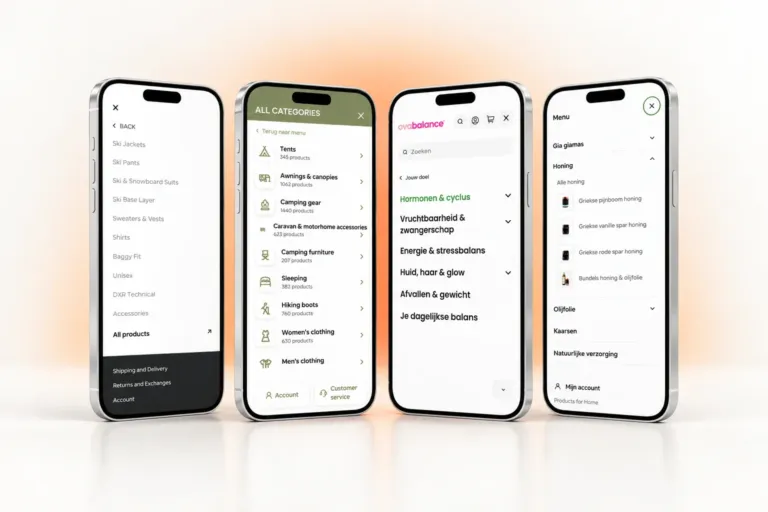
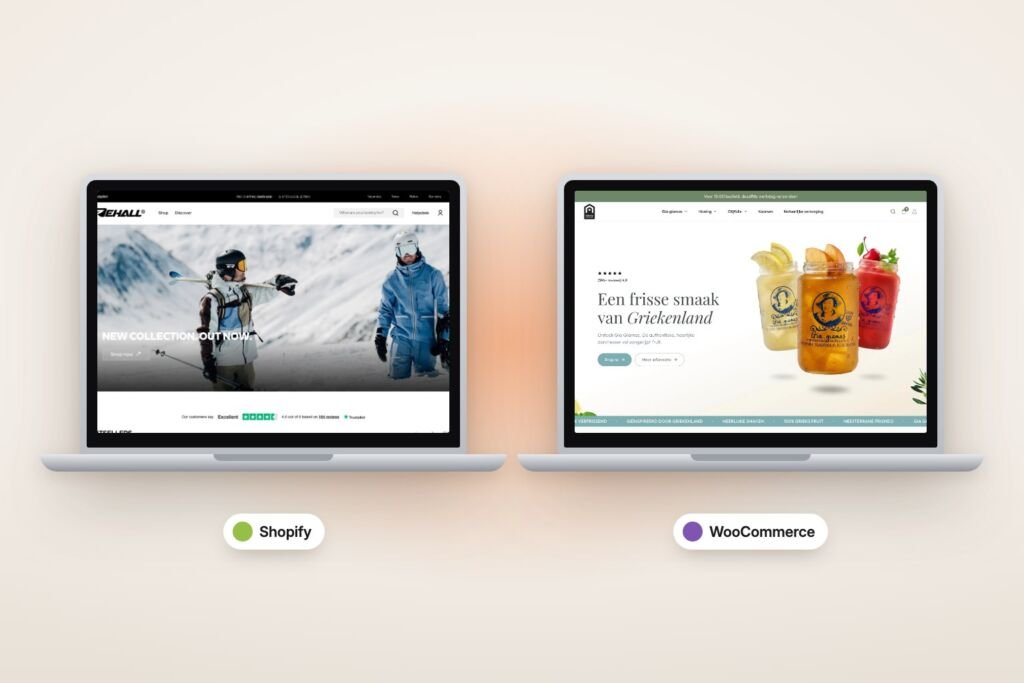
We build on both: Shopify stores for Rehall, Ovabalance and Kampeerwinkel Roermond, and a WooCommerce store for Products for Home. It answers the Dutch question “Shopify of WooCommerce?” point by point. Every third-party price and feature was checked on official pages in October 2026.
Shopify vs WooCommerce at a glance
| Shopify | WooCommerce | |
|---|---|---|
| Software cost | €24–€289 a month on yearly billing; Plus from €2,100 | Free, with no platform fee or revenue share |
| Hosting and security | Included; PCI DSS Level 1 for every store | Your host; WooCommerce estimates $25–$350 a month |
| iDEAL | Wero | Shopify Payments, €0.29; other providers add a 2% to 0.2% Shopify fee | Mollie plugin, €0.32, no platform fee |
| Languages | Markets and Translate & Adapt, free | WPML, Polylang or Weglot, paid for shops |
| Checkout | Information, shipping and payment steps extendable only on Plus | Fully editable, for example with FunnelKit |
| URLs | Fixed /products/ and /collections/ folders | Product, category and tag bases editable |
| Upkeep | Shopify updates the platform; you manage theme and apps | You update WordPress, WooCommerce and every plugin |
Total cost of ownership
Shopify: one invoice, plus fees
Shopify’s euro plans cost €24, €69 or €289 a month on yearly billing for Basic, Grow and Advanced (€32, €92 or €384 billed monthly), and Plus starts from €2,100, according to its Belgian and Irish pricing pages (October 2026). Prices depend on your store’s location, so check Shopify’s Dutch pricing page. Hosting is included; apps and themes are billed in US dollars and converted with a 1.5% fee.
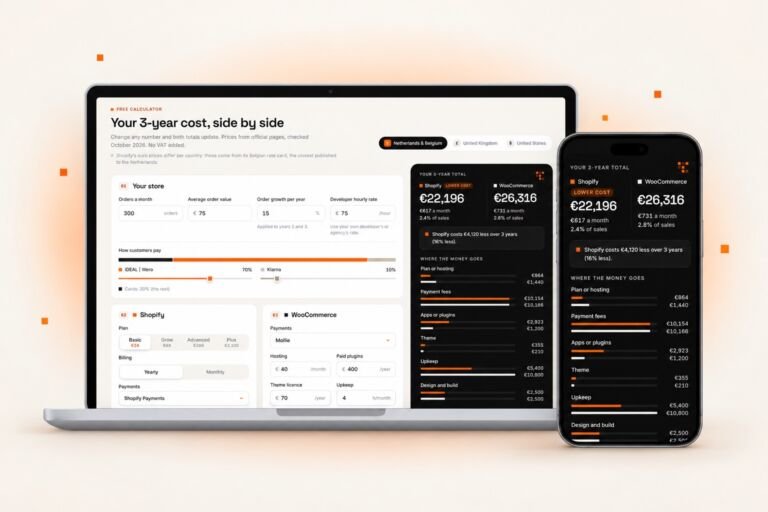
Want your own numbers? Our free Shopify vs WooCommerce cost calculator runs a 3-year total with your orders, payment mix, apps, hosting and upkeep, for Dutch, German, UK and US stores. It is also available in Dutch.
WooCommerce: free software, paid everything around it
WooCommerce’s pricing page describes the plugin as free to download and use, with no platform fee or revenue share, and puts extensions at $29 to $299 a year each.
$25–$350
WooCommerce’s own estimate of monthly hosting costs for most stores, scaling with traffic and performance needs.
Typical extras for a Dutch shop: WPML Multilingual CMS costs €99 for the first year, WooCommerce Subscriptions $279 a year and FunnelKit’s Plus plan, with order bumps and one-click upsells, $149.50 a year at its October 2026 discount (normally $299). Then add the hours to update and test WordPress, WooCommerce and every plugin.
Compare three years, not one month
Shopify’s costs arrive on one invoice; WooCommerce’s are spread across a host, licence renewals and developer hours. Put both on one sheet for three years, with payment fees at your real order volume.
Dutch payments: iDEAL | Wero, Bancontact, Klarna and Mollie
On Shopify, Shopify Payments shows iDEAL | Wero to customers with a Dutch address paying in euros, at €0.29 per payment on Shopify’s euro rate card, and Bancontact to customers in Belgium. Kampeerwinkel Roermond’s checkout offers six methods, including iDEAL | Wero, Klarna, Shop Pay and KBC/CBC. Mollie also works on Shopify through its free app, but Shopify then adds its third-party fee to every order, which Shopify Payments orders avoid.
On WooCommerce, the usual route is Mollie Payments for WooCommerce, a free plugin by Mollie with more than 100,000 active installations. Mollie’s pricing page lists €0.32 per iDEAL | Wero payment, 1.80% + €0.25 for consumer cards from the European Economic Area, 1.40% + €0.25 for Bancontact and 2.99% + €0.45 for Klarna in the Netherlands and Belgium (October 2026). WooCommerce adds no fee of its own. Products for Home offers five ways to pay, from iDEAL | Wero to bol.checkout.
| Shopify Payments | Mollie on Shopify Basic | Mollie on WooCommerce | |
|---|---|---|---|
| Payment provider fee | €0.29 | €0.32 | €0.32 |
| Platform fee | None | 2% of €60 = €1.20 | None |
| Total for one order | €0.29 | €1.52 | €0.32 |
Shipping: Sendcloud, MyParcel and PostNL
Shipping is close to a draw. Sendcloud has a Shopify app and its own WooCommerce plugin, free for up to 20 parcels a month, and MyParcel integrates with both and prints PostNL, DHL, DPD and UPS labels. PostNL publishes a free PostNL for WooCommerce plugin; on Shopify, PostNL labels usually run through Sendcloud, MyParcel or a third-party app.
On Shopify, live third-party carrier rates at checkout start on the Advanced plan. Free-delivery thresholds per country need care on both: Products for Home’s cart counts down to €60 in the Netherlands and €70 in Belgium, as our guide to increasing average order value in WooCommerce explains.
Multilingual stores: Markets or WPML, Weglot and Polylang
Shopify does more out of the box. Country markets come with every plan, Translate & Adapt is free, stores in the Netherlands can translate up to 8 languages automatically and Shopify generates hreflang tags from your set-up. You can sell in up to 20 languages, or 30 on Plus. Rehall and Kampeerwinkel Roermond both sell in Dutch, English and German from one store.
WooCommerce needs a plugin. WPML’s Multilingual CMS plan, with WooCommerce support, costs €99 for the first year. Polylang is free, but Polylang for WooCommerce costs from €99 a year. Weglot costs from €15 a month for one language and 10,000 words, counted across all languages, so a large catalogue needs a bigger plan. Either way, our multi-language Shopify store guide lists what usually gets missed.
B2B and wholesale
Shopify B2B is included on every plan, with up to 3 active catalogues below Plus and unlimited catalogues on Plus, according to Shopify’s documentation on market types. On WooCommerce, wholesale prices and company accounts come from extensions such as B2B for WooCommerce ($149 a year, October 2026) or custom development.
Speed, security and maintenance
Shopify hosts the store and is certified PCI DSS Level 1 for every store on the platform. You manage the theme and apps, and every app can add scripts. Kampeerwinkel Roermond, with more than 9,400 products, has a mobile LCP of 2.2 seconds in Chrome UX Report data for the 28 days to 8 October 2026, and its desktop pages pass Core Web Vitals.
On WooCommerce, the host and your developer carry that work. WooCommerce’s caching guide says the cart, checkout and My Account pages must stay dynamic, so page caching can’t hide a slow checkout. WordPress, WooCommerce, the theme and every plugin need regular updates, with a test after each. Products for Home’s storefront runs on 42 custom Bricks elements that we built and keep improving.
Don’t choose WooCommerce without a maintenance plan
Plugins left without updates are a security and stability risk, and the checkout is where a breakage costs money. Agree who updates, tests and monitors the store before launch. Our support and maintenance plans are quoted per site.
Flexibility, ownership and SEO
Shopify uses fixed folders: products sit under /products/ and collections under /collections/, and you edit only the handle after the slash. WooCommerce lets you change the product base, for example to your shop page plus category, and rename category and tag bases. Fixed folders rarely decide rankings on their own; they matter most when you migrate, because every old URL then needs a redirect.
WooCommerce is open-source software on hosting you control, so any part of it can change. On Shopify, the platform’s rules apply, such as three options per product and checkout limits below Plus. With us, you own the code on either platform.
Checkout customisation
On every Shopify plan you can brand the checkout and add apps to the Thank you and Order status pages, but apps that change the information, shipping and payment steps only run on Plus. Below Plus, an extra offer or custom field inside those steps is off the table.
WooCommerce’s checkout is yours to change. For Products for Home we built a FunnelKit checkout funnel with a side cart, a free-shipping progress bar, an order bump and three one-click extras. The store made 40%+ more sales from the checkout funnel (AvixDigital project data, 2026).
Case study · WooCommerce · Netherlands & Belgium
Products for Home: a WooCommerce store with a checkout funnel
A Dutch shop for Greek honey, olive oil and drinks, built on a custom Bricks element library with a FunnelKit checkout funnel. Sales figure: AvixDigital project data, 2026.
- 40%+ more sales from the WooCommerce checkout funnel
- 5 payment methods at checkout, from iDEAL | Wero to bol.checkout
- 4 add-on offers in the checkout: one order bump and three one-click extras
Shopify or WooCommerce: which should you choose?
Here is how the WooCommerce vs Shopify choice usually plays out for shops in the Netherlands:
| Your situation | Our pick | Why |
|---|---|---|
| No developer in-house | Shopify | Hosting, security and platform updates are handled for you |
| Selling in Dutch, English and German | Shopify | Markets, free translation and automatic hreflang on every plan |
| A content-led brand already on WordPress | WooCommerce | One site for content and shop, with editable URLs |
| A custom checkout funnel without a Plus budget | WooCommerce | Order bumps, extra fields and one-page checkouts are yours to build |
| Mollie as your main payment provider | WooCommerce | No platform fee; on Shopify, 2% to 0.2% per order |
| Subscriptions | Either | Shopify Subscriptions is free, with Recharge or Juo for more; WooCommerce Subscriptions costs $279 a year |
| Wholesale with many price lists | Shopify Plus or WooCommerce | Unlimited B2B catalogues on Plus; extensions or custom code on WooCommerce |
For Dutch brands without a developer on call, we usually recommend Shopify, and it stretches further than many expect: Ovabalance’s bespoke Shopify theme runs a custom subscription selector with three ways to buy each of its 43 products. When the checkout itself is the project, WooCommerce gives more room.
Case study · Shopify · Netherlands, Belgium & Germany
Rehall: a three-language Shopify store for skiwear
A custom Shopify theme built from a pixel-perfect design, with a mega menu, predictive search and technical spec filters.
- 3 storefront languages: English, Dutch and German
- 9 third-party apps running in the theme, from Rebuy to Judge.me
- 4 mega menu departments: Men, Women, Boys and Girls
Moving from WooCommerce to Shopify
Shopify’s WooCommerce migration guide offers a Store Migration app, in early access, that imports products; products with more than three options lose them. Customers move by CSV and order history needs a third-party app. Because the link structure differs, every old URL needs a redirect before the domain moves.
- URLs: match every indexed URL to its new /products/ or /collections/ address.
- Options: restructure products with more than three variation attributes.
- Payments: move to Shopify Payments, or budget the third-party fee.
- Plugins: match each plugin to an app, a theme feature or nothing.
- Checkout: place test orders with Dutch and Belgian addresses.
Our WooCommerce to Shopify migration service handles the redirect map, data and launch. Staying put? Our WooCommerce development team improves existing stores, and our Shopify development for Dutch brands covers new builds. Webshops on either platform start from €2,500 excluding VAT, at a fixed price: see our pricing.
Want the full budget? Our guide to how much a Shopify store costs in the Netherlands prices every line, from the plan and iDEAL fees to apps and the build.
Still deciding between Shopify and WooCommerce?
Tell us your catalogue, markets, payment methods and who will run the store. On a free 30-minute video call we’ll recommend a platform and explain what the build involves.
Frequently asked questions
Is Shopify or WooCommerce cheaper for a Dutch webshop?
WooCommerce has no software fee, but you pay for hosting, extensions and maintenance; WooCommerce puts hosting at $25 to $350 a month for most stores. Shopify’s euro plans cost €24 to €289 a month on yearly billing, hosting included. Payment fees and developer time usually decide it over three years.
Can I accept iDEAL on Shopify and WooCommerce?
Yes. Shopify Payments offers iDEAL | Wero to Dutch customers paying in euros, at €0.29 per payment on its euro rate card. On WooCommerce, Mollie’s free plugin adds it at €0.32. Mollie also works on Shopify, but Shopify then adds its third-party fee.
Is Shopify or WooCommerce better for SEO?
Both can rank well. Shopify fixes the /products/ and /collections/ folders and generates hreflang tags automatically. WooCommerce lets you change permalink bases, but speed and plugins are your responsibility. Content, speed and internal links usually matter more than the platform.
Which is better for a store in Dutch, English and German?
Shopify needs less set-up: markets on every plan, the free Translate & Adapt app and automatic hreflang tags. WooCommerce needs WPML, Polylang for WooCommerce or Weglot. On both, plan a native speaker’s review.
Can I move from WooCommerce to Shopify without losing rankings?
You can protect them with a complete redirect map: every indexed product, category and page URL redirected to its new Shopify address before the domain moves. Then check Search Console for crawl errors in the weeks after launch.
Do I own my store on Shopify?
You own your content and, when a custom theme is built for you, its code, but not the platform, so Shopify’s rules apply. WooCommerce is open source on hosting you choose. With AvixDigital, you own the code on either platform.