


In this article15 sections
Your website is more than a collection of pages. It is often the first interaction a potential customer has with your business—and it can directly influence trust, conversions, and revenue.
That makes choosing who builds it an important business decision.
A freelancer may offer lower costs, direct communication, and flexibility. A web development agency typically provides a broader team, structured project management, quality assurance, and long-term support.
Neither option is automatically better. The right choice depends on your budget, project complexity, deadline, internal resources, and growth plans.
This guide compares hiring a web development agency vs. a freelancer so you can choose the right development partner for your business.
Web Development Agency vs. Freelancer: Quick Comparison
| Factor | Freelancer | Web Development Agency |
|---|---|---|
| Upfront cost | Usually lower | Usually higher |
| Expertise | Often specialised in one area | Multidisciplinary team |
| Project capacity | Limited by one person | Distributed across a team |
| Communication | Usually direct | Managed through a project lead |
| Quality assurance | Depends on the individual | Structured testing and review |
| Availability | May fluctuate | More consistent coverage |
| Scalability | Limited | Easier to scale |
| Post-launch support | Varies | Usually structured |
| Best for | Small, focused projects | Complex, business-critical projects |
The short answer: Hire a freelancer for a focused assignment with a clear scope and manageable risk. Choose an agency when your website must generate revenue, support complex functionality, or scale with your business.
What Is a Freelance Web Developer?
A freelance web developer is an independent professional who works directly with clients on a contract or project basis.
Some freelancers are generalists who handle design, development, deployment, and basic SEO. Others specialise in a particular area, such as:
- WordPress development
- Shopify theme customisation
- Webflow implementation
- Front-end development
- Back-end engineering
- Website performance optimisation
- API integration
- Technical maintenance
A skilled freelancer can be an excellent choice when your project is well-defined and closely matches their expertise.
However, even an experienced freelancer has limited capacity. If your project requires strategy, UI/UX design, development, SEO, testing, and ongoing support, one person may struggle to deliver every discipline at the same level.
What Is a Web Development Agency?
A web development agency is a structured team of specialists that plans, designs, develops, tests, launches, and maintains digital products.
Depending on the project, an agency team may include:
- Digital strategists
- UI/UX designers
- Front-end developers
- Back-end developers
- Shopify, WordPress, or Webflow specialists
- Project managers
- SEO professionals
- Quality assurance specialists
- Conversion optimisation experts
Instead of depending on one person to handle every requirement, an agency distributes the work across specialists.
This model is particularly valuable for businesses that view their website as a long-term growth platform rather than a one-time design project.
Benefits of Hiring a Freelancer
1. Lower Upfront Cost
Freelancers generally have fewer operating expenses than agencies, allowing them to offer lower project or hourly rates.
This can be attractive for startups validating an idea, small businesses with limited budgets, or companies that only need a specific website update.
However, the lowest proposal does not always produce the lowest total cost. Rebuilding incomplete work, fixing performance issues, or correcting poor technical architecture can quickly eliminate the original savings.
2. Direct Communication
When working with a freelancer, you usually communicate directly with the person completing the work.
This can simplify feedback and reduce communication layers, particularly when the project is small and does not require coordination between multiple specialists.
3. Greater Flexibility
Freelancers may offer more flexibility with:
- Working hours
- Short-term engagements
- Small revisions
- Urgent fixes
- Milestone-based contracts
This makes them useful for focused assignments and temporary development support.
4. Specialised Expertise
Some freelancers are highly experienced in a specific platform or technical area.
If your project requires one clearly defined capability, hiring a proven specialist may be more efficient than engaging an entire agency.
Risks of Hiring a Freelancer
1. Single-Person Dependency
The biggest operational risk is that the entire project depends on one person.
Illness, scheduling conflicts, emergencies, or competing client work can delay delivery. If the freelancer becomes unavailable, there may be no immediate replacement.
This risk becomes more serious when the website is connected to a product launch, marketing campaign, or revenue target.
2. Limited Range of Expertise
A successful website requires more than code. A commercial website may involve:
- Brand positioning
- Information architecture
- User experience design
- Responsive development
- Accessibility
- Technical SEO
- Conversion optimisation
- Analytics
- Security
- Quality assurance
One freelancer may perform several of these tasks, but it is difficult for one person to be an expert in all of them.
3. Capacity Constraints
A freelancer can only complete a limited amount of work at one time. Complex requirements or frequent scope changes can create bottlenecks.
Scaling the project may require hiring additional freelancers, leaving you responsible for coordinating multiple independent contractors.
4. Inconsistent Post-Launch Support
Some freelancers provide excellent documentation and ongoing support. Others may hand over the website without a formal maintenance process.
Before hiring, establish who will be responsible for:
- Security updates
- Website backups
- Bug fixes
- Hosting issues
- Performance monitoring
- Future feature development
Benefits of Hiring a Web Development Agency
1. Access to a Complete Team
An agency gives you coordinated access to multiple disciplines.
A strategist can define the project direction, a designer can focus on the user experience, developers can build the platform, and quality assurance specialists can test it before launch.
This specialisation generally produces a more consistent result than expecting one person to manage every part of the project.
2. Structured Project Management
Professional agencies typically use:
- Defined deliverables
- Project milestones
- Approval stages
- Technical documentation
- Design systems
- Testing procedures
- Launch checklists
- Communication schedules
This structure makes responsibilities, timelines, and expectations clearer.
It also reduces the risk of uncontrolled scope, missed requirements, and expensive rework.
3. Greater Reliability
If one team member becomes unavailable, the project does not necessarily stop. Another specialist can usually provide support or take over the work.
This continuity is valuable for projects with strict deadlines or business-critical functionality.
4. Better Scalability
An agency can expand its resources as your project grows.
Your initial website may eventually need:
- E-commerce functionality
- Custom integrations
- Marketing automation
- Multilingual content
- Advanced analytics
- Customer portals
- Conversion optimisation
- Ongoing technical support
An established agency can usually provide these services without forcing you to rebuild your vendor network.
5. Dedicated Quality Assurance
Quality assurance should involve more than checking whether a page loads.
A professional testing process may cover:
- Mobile responsiveness
- Browser compatibility
- Form functionality
- Checkout journeys
- Accessibility
- Page speed
- Broken links
- Error handling
- Security configuration
- Analytics tracking
This reduces the likelihood of discovering critical problems after launch.
6. Long-Term Strategic Support
A strong agency does not disappear when the website goes live.
It can continue improving the platform based on analytics, user behaviour, conversion data, and changing business requirements.
This makes an agency especially valuable when your website directly supports sales, customer acquisition, or business operations.
Potential Disadvantages of Hiring an Agency
Higher Initial Investment
An agency generally costs more because the project involves multiple specialists, project management, quality assurance, and operational support.
The important question is not simply:
Which option is cheaper?
A better question is:
Which option provides the lowest risk and strongest return over the website’s useful life?
More Formal Processes
Agencies may use structured discovery, approval, and revision processes.
This can feel slower than messaging a freelancer directly, but the structure helps prevent misunderstandings, uncontrolled changes, and expensive redevelopment.
Managed Communication
You may not communicate directly with every specialist working on your project.
However, a capable project manager should improve communication by translating your business requirements into clear design and technical deliverables.
When Should You Hire a Freelancer?
A freelancer is usually the better choice when:
- Your project is small and clearly defined.
- You only require one specialised skill.
- Your budget is limited.
- The work is not business-critical.
- You can manage the project internally.
- You already have approved designs and specifications.
- You need occasional maintenance or fixes.
- Your deadline is flexible.
- The project does not require several specialists.
Typical freelance assignments include:
- Fixing a WordPress issue
- Customising an existing Shopify section
- Building a landing page from an approved design
- Improving website performance
- Integrating a documented API
- Providing temporary development support
When Should You Hire a Web Development Agency?
A web development agency is generally the better investment when:
- Your website is expected to generate leads or revenue.
- You need strategy, design, and development.
- Your project includes complex integrations.
- You are building or scaling an e-commerce business.
- Brand consistency is important.
- You have a fixed launch deadline.
- Security or regulatory requirements apply.
- Multiple stakeholders are involved.
- You need dependable post-launch support.
- The website must scale with your business.
For these projects, hiring a coordinated team can reduce delivery risk and prevent expensive technical debt.
We Have Worked Both Ways
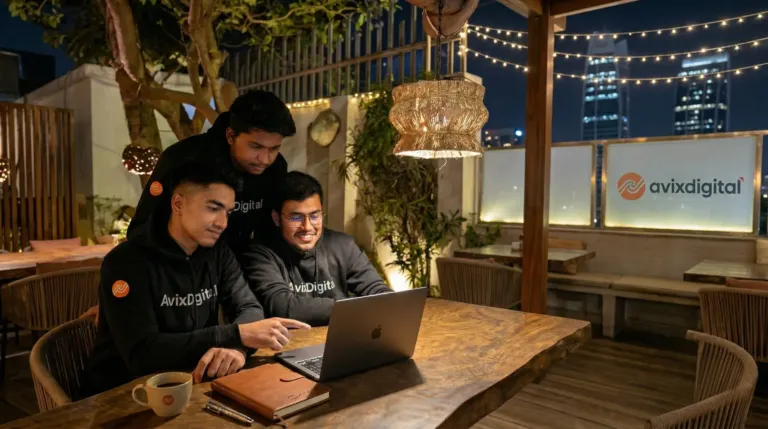
We have seen this decision from both sides. AvixDigital started with independent freelance work on Fiverr, and those freelance projects built the client base behind the agency. Today, projects are delivered by a team of designers and developers led by our founder, Akib Zawayed.
That is why this guide does not crown one option. A freelancer can be the right call for a focused task. A team makes more sense when a project needs design, development, testing and support at the same time. You can see the work our team delivers in our case studies, including Shopify, WooCommerce and Webflow builds for Dutch brands.
What Does Each Option Really Cost?
Freelancers usually appear less expensive because you are purchasing one person’s time and expertise.
With an agency, you are purchasing a managed delivery system that may include research, strategy, design, development, testing, documentation, and support.
To compare proposals fairly, evaluate the total cost of ownership:
- Discovery and planning
- Design and development
- Internal project management time
- Revisions and delays
- Third-party tools
- Hosting and maintenance
- Bug fixes
- Security updates
- Lost revenue caused by poor performance
- Future redevelopment
A cheap website that requires replacement after a year may ultimately cost more than a scalable website built correctly from the beginning.
If you are comparing agency quotes, our pricing page shows our starting prices and what each package includes.
Questions to Ask Before Hiring
Whether you choose a freelancer or an agency, ask these questions before signing a contract:
- Have you completed projects similar to mine?
- Can I review live examples and verified client feedback?
- Who will work on my project?
- What is included and excluded from the proposal?
- How will milestones and approvals be managed?
- How do you test performance, accessibility, and responsiveness?
- Who will own the website, design files, and source code?
- What happens if the timeline or scope changes?
- What post-launch support is included?
- How will the website support future business growth?
Avoid choosing solely based on the lowest quote.
Compare each provider’s relevant experience, communication quality, development process, technical approach, and ability to support your business after launch.
Web Development Agency vs. Freelancer: Final Verdict
Choose a freelancer when you have a small, focused assignment, a limited budget, and the ability to manage the work internally.
Choose a web development agency when your website is strategically important, requires multiple skills, includes complex requirements, or must support long-term growth.
Your decision should reflect the cost of failure as much as the cost of development.
For a small internal website, the risk may be manageable. For an e-commerce store, lead-generation platform, customer portal, or custom application, choosing a team with broader capabilities and dependable support is usually the safer commercial decision.
Build a Website Designed for Long-Term Growth
AvixDigital grew out of freelance web development that began in 2020, and it holds a 5.0 rating from 118 reviews on Fiverr.
Our web development services include:
- Digital strategy and website audits
- Conversion-focused UI/UX design
- Shopify and Shopify Plus development
- WordPress and Webflow development
- Custom full-stack solutions
- Performance and conversion optimisation
- Quality assurance
- Ongoing technical support
Whether you are launching a new brand or scaling an established business, we can help you build a fast, scalable, and conversion-focused digital platform.
Frequently Asked Questions
Is it cheaper to hire a freelancer or a web development agency?
A freelancer usually has a lower upfront cost. An agency may provide better total value for complex projects by including strategy, specialist expertise, project management, testing, and ongoing support.
Is an agency better than a freelance web developer?
An agency is generally better for large, complex, or business-critical projects. A skilled freelancer may be more efficient for a smaller assignment requiring one specific capability.
How do I choose between an agency and a freelancer?
Evaluate your project’s complexity, deadline, budget, required expertise, internal management capacity, and need for post-launch support. You should also consider how much your business could lose if the project is delayed or built incorrectly.
Can a freelancer build a professional business website?
Yes. An experienced freelancer can build an excellent website, particularly when the scope is clear and closely matches their specialisation. The main limitations are individual capacity, availability, and breadth of expertise.
What should be included in a web development contract?
The contract should define the scope, deliverables, milestones, payment terms, revision limits, ownership rights, third-party expenses, launch responsibilities, warranties, and post-launch support.